If you have ever stood on the misty ridgelines of Bali, watched morning incense spiral upward from a woven palm basket, or observed neighbors building elaborate bamboo arches together, you have witnessed Tri Hita Karana in motion. Far more than an academic concept, this ancient Sanskrit-derived philosophy is the living blueprint that guides Balinese spiritual practice, social organization, water distribution, and ecological balance.
For centuries, the Balinese have maintained that true human happiness and prosperity (sukham) cannot exist in isolation. Personal success is considered meaningless if it damages communal harmony or degrades the natural world. In a modern era marked by rapid globalization, overtourism, and climate anxiety, the lessons embedded in Tri Hita Karana offer a profound model of sustainable, conscious existence.
1. Etymology and Historical Roots of Tri Hita Karana
The term Tri Hita Karana originates from Sanskrit linguistics and classical Old Javanese literature:
- Tri means “three.”
- Hita translates to “prosperity,” “happiness,” “wellbeing,” or “auspicious goodness.”
- Karana signifies “causes,” “reasons,” or “sources.”
Translated as a holistic principle, Tri Hita Karana signifies “the three primary causes of wellbeing and spiritual prosperity.” While the conceptual framework has permeated Balinese Hindu theology since the arrival of sacred sages from the Majapahit and pre-Majapahit eras, the specific phrase was formally codified during a regional conference of Balinese Hindu scholars (Badan Perjuangan Umat Hindu) at the Dwijendra University in Denpasar on November 11, 1958. It draws its canonical authority from the ancient Vedic and Bhagavad Gita texts, notably Chapter 3, Verse 10, which teaches that the supreme Creator generated mankind alongside the spirit of sacrificial harmony with nature and divinity.
2. The Three Sacred Pillars of Harmony
The philosophy is articulated through three interdependent pillars. When all three are maintained in delicate equilibrium, society experiences peace (kanti) and health (swasti). If any single relationship is neglected, cosmic and societal imbalance (leteh or disharmony) inevitably follows.
Pillar 1: Parahyangan (Harmonious Relationship with the Divine)
Parahyangan governs the spiritual relationship between human beings and the supreme divine force, known in Balinese Hinduism as Ida Sang Hyang Widhi Wasa, alongside the ancestral spirits (Pitara) and local deities (Batara). This relationship is characterized by unceasing gratitude, humility, and devotional service (Bhakti).
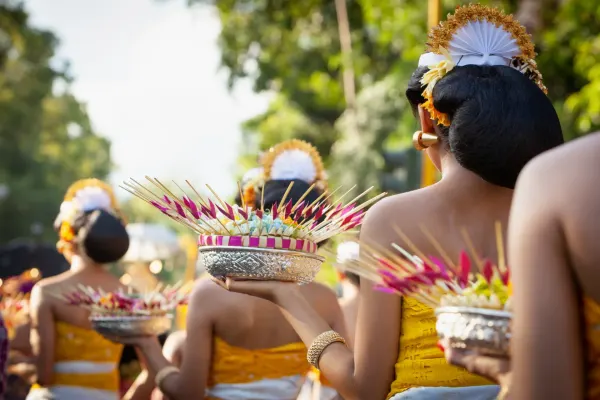
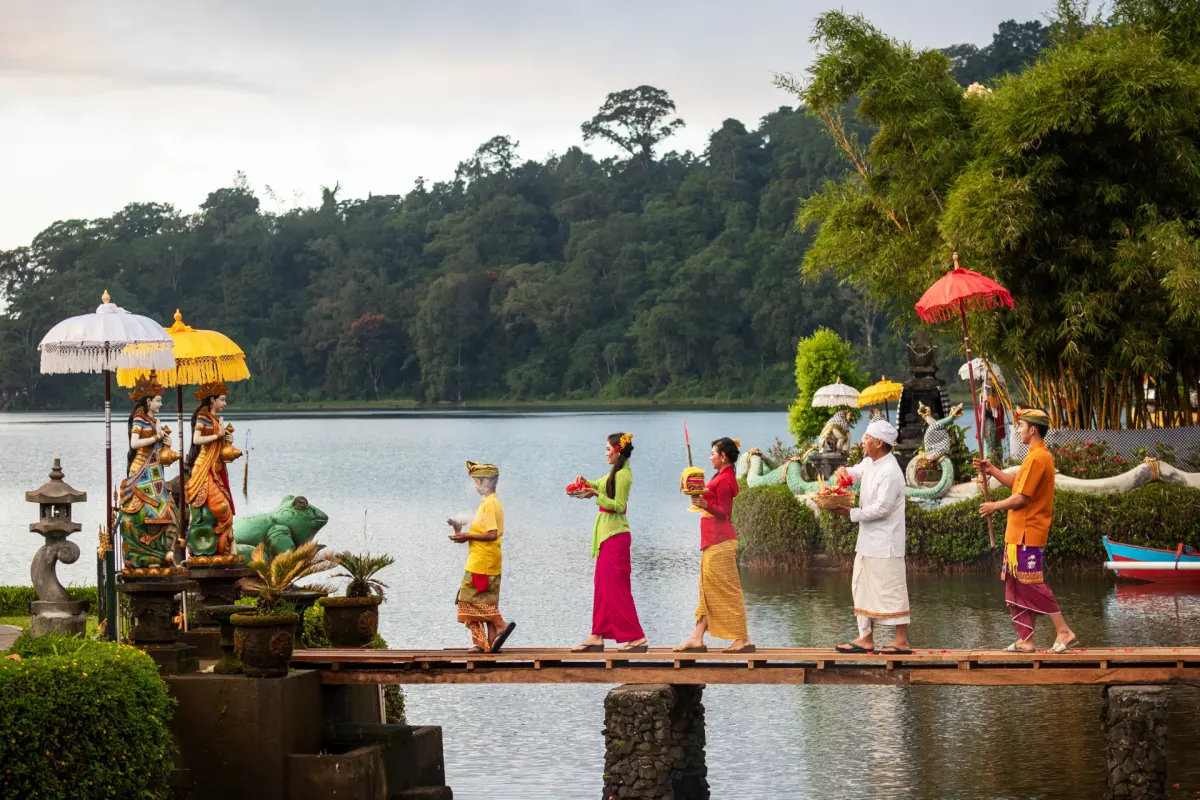
In daily Balinese life, Parahyangan is tangible. Every morning, Balinese women weave and present delicate Canang Sari offerings to thank the cosmos for life, breath, and harvest. Parahyangan determines the architectural sacred quadrant (Kaja-Kangin, toward Mount Agung and the rising sun) where family shrines (Sanggah) and village mother temples (Pura Kahyangan Tiga) are erected.
Pillar 2: Pawongan (Harmonious Relationship Among Humans)
Pawongan addresses the social sphere: interpersonal empathy, communal cooperation, and collective responsibility among human beings. Balinese culture rejects aggressive individualism in favor of deep social solidarity, summarized in indigenous proverbs such as Tat Twam Asi (“I am you, and you are me”) and Sagilik-Saguluk Salunglung Sabayantaka (“United in joy and sorrow”).
The organizational engine of Pawongan is the Banjar—the traditional neighborhood hamlet. In the Banjar, decisions are reached through consensus (musyawarah), ceremonies like the erection of towering Galungan Penjor are built collaboratively through gotong royong (communal labor), and families support one another during life crises, weddings, and cremations.
Pillar 3: Palemahan (Harmonious Relationship with the Environment)
Palemahan represents the stewardship of the physical environment, flora, fauna, soil, and waterways. Balinese Hinduism does not view nature as inert material to be exploited, but as a living manifest body of God (Bhuwana Agung, the macrocosm), while the human body is Bhuwana Alit (the microcosm). What harms the earth inevitably harms the human soul.
Palemahan is honored through specialized ceremonial days throughout the 210-day calendar cycle. For instance, on Tumpek Uduh (or Tumpek Wariga), the Balinese perform blessings for fruit trees, coconut palms, and crops, acknowledging their life-giving bounty. On Tumpek Kandang, domestic livestock and animals are consecrated. Through ritual reverence, conservation becomes an innate spiritual duty rather than an external regulatory burden.
3. Tri Hita Karana in Action: Rice Terraces, Temples, and Clean Villages
Tri Hita Karana is not confined to textbooks; it is carved into Bali’s physical geography. Three world-renowned examples demonstrate this living philosophy:
The Subak Irrigation Network
Bali’s multi-tiered emerald rice terraces, such as those in Jatiluwih and Tegallalang, are not merely agricultural farms—they are living hydraulic temples. Farmers organize into cooperative water management units called Subak. The Subak system merges Parahyangan (worship at water source temples like Pura Ulun Danu Beratan), Pawongan (strictly democratic water sharing where downstream and upstream farmers receive equitable allocations), and Palemahan (natural pest control via synchronized fallow flooding).
The Traditional Village Layout: The Case of Penglipuran
In high-altitude Bangli Regency, the ancient settlement of Penglipuran Village exhibits the flawless spatial manifestation of Tri Hita Karana. The village is split into three zones along a sacred north-south axis:
- Utama Mandala (Sacred Northern Zone): Dedicated to the village temple (Parahyangan).
- Madya Mandala (Central Residential Zone): Symmetrical, identical compounds facing a central stone pathway where neighbors socialize and live (Pawongan).
- Nista Mandala (Southern Zone): Cemetery, bamboo forests, agricultural land, and waste processing (Palemahan).
4. How Travelers Can Honor Tri Hita Karana
As international visitors explore the island, engaging with Tri Hita Karana transforms a superficial holiday into a transformative, culturally respectful journey. Here is how travelers can practice each pillar during their stay:
| Pillar | Sacred Meaning | Practical Traveler Action |
|---|---|---|
| Parahyangan | Divine connection & respect for spiritual spaces | Wear a traditional sarong and sash at temples; avoid stepping on sidewalk offerings; never pose disrespectfully upon sacred banyan trees or temple shrines. |
| Pawongan | Social harmony & human dignity | Greet locals with a gentle smile and “Om Swastiastu”; practice fair bargaining without anger; tip drivers, waitstaff, and local guides generously; respect local quiet hours. |
| Palemahan | Environmental balance & nature care | Refuse single-use plastics; carry a reusable water flask; support eco-conscious homestays and organic warungs; respect wildlife and leave natural beaches pristine. |
5. Frequently Asked Questions (FAQ)
Is Tri Hita Karana a religion or a cultural philosophy?
Tri Hita Karana is rooted in Balinese Hindu scriptures, but it operates as a universal ethical philosophy. Because its principles focus on relationship integrity—toward faith, fellow humans, and nature—it can be applied by anyone, regardless of religious background, seeking a balanced and regenerative lifestyle.
How does Tri Hita Karana differ from Western sustainability concepts?
Western sustainability often frames environmentalism through economic models, carbon credits, or resource efficiency. In contrast, Tri Hita Karana treats ecology as fundamentally sacred. By placing nature (Palemahan) alongside divine reverence (Parahyangan) and human compassion (Pawongan), caring for the planet becomes a sacred spiritual devotion rather than an industrial compromise.
Where is the best place in Bali to learn about Tri Hita Karana?
While the philosophy permeates every corner of the island, visiting Penglipuran Village in Bangli or staying near the cultural sanctuary of Ubud allows travelers to witness how community banjars, organic family farms, and temple societies integrate these three pillars into daily modern routines.